
Kanawha Previous-Resident Source Eras
No single roll lists everyone who lived at an address. Assessment and deed sources identify owners, while directories, census schedules, and newspapers can reveal past residents. Begin with the source closest to the target date and preserve its limits. A current parcel record is an annual tax snapshot. An old directory may reflect a canvass completed before its cover year.
| Source | Time covered | Record keeper | Evidence found |
|---|---|---|---|
| Assessor property search | Current assessment | Kanawha County Assessor / MapWV | Owner, situs, mailing address, legal description, sales |
| Kanawha land books | 1791-1962 online range stated | Kanawha County Assessor | Historic tax ownership; scanning continues |
| Deeds and indexes | Deeds 1790-1910; grantor 1790-1946; grantee 1795-1967 on archive film | County Clerk / WV State Archives | Transfers, parties, and legal descriptions |
| Polk Charleston directories | 1908-present, gaps unlisted | KCPL Main | Occupant, address, work, and household notation |
| Federal census schedules | Public through 1950 under the 72-year rule | National Archives and library access | Household members, ages, relations, work |
| Charleston newspapers | Daily Mail 1914-current; Gazette 1924-current | KCPL Main microfilm | Obituaries, notices, moves, and local events |
| Probate and fiduciary film | Wills 1820-1968; fiduciary 1871-1968 | County Clerk / WV State Archives | Heirs, estate links, and address clues |
For a recent property, start online with the assessor. For an early deed, use the County Clerk Record Room or Archives microfilm. For the people who occupied a Charleston-area address, compare the Polk shelf with a census and newspaper date.
Start Kanawha Previous-Resident History
The free Kanawha County Assessor Property Record Search accepts an address, owner, account, district, map and parcel, legal description, or deed book and page. Save the current owner, parcel ID, tax district, physical or E-911 address, legal description, sales history, and newest book/page reference. Owner names use LAST NAME FIRST NAME without commas.
A tax mailing address is where the owner receives mail. It may not be the property's physical site and does not prove residence. The statewide parcel schema makes that distinction explicit, and one parcel can carry more than one E-911 address. Treat a parcel as land evidence, not a household list.
The official MapWV assessment detail shows how sales, book/page, owner mailing data, and physical property fields appear together.
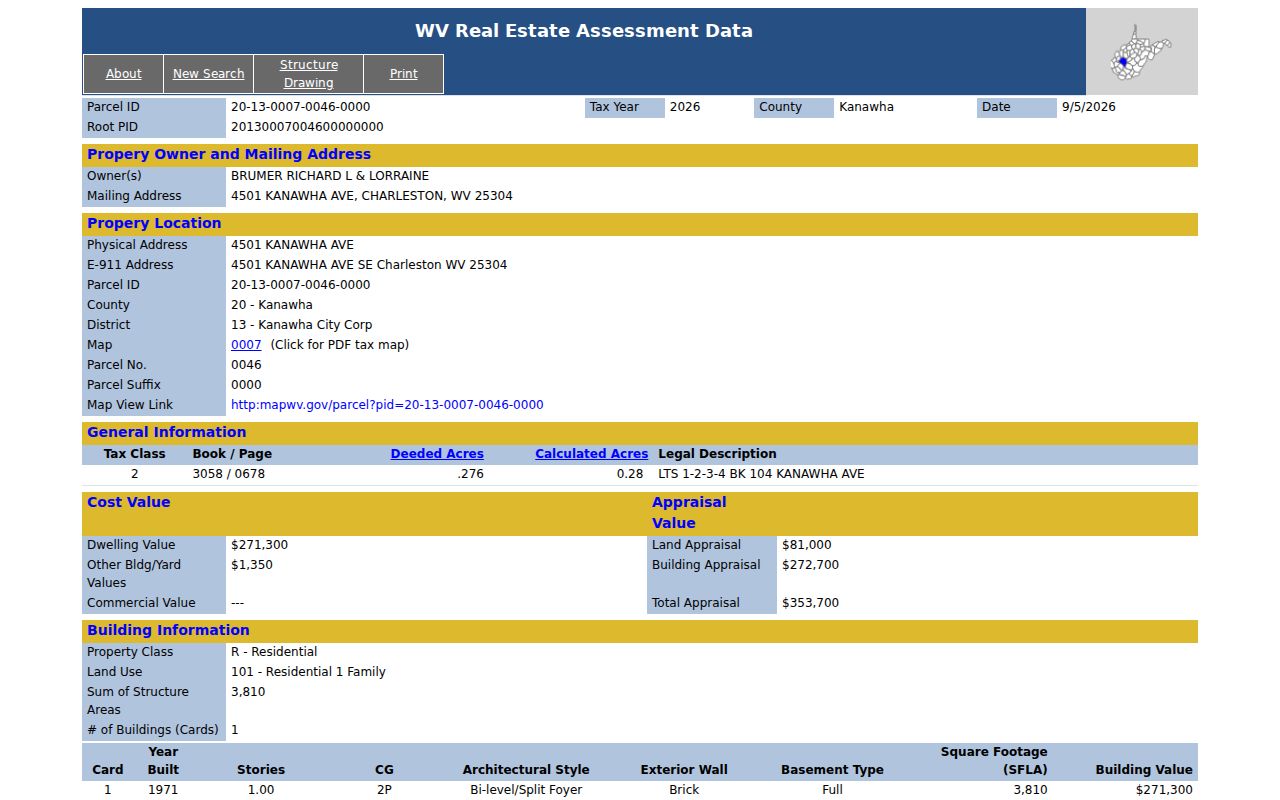
The parcel screen supplies a handoff into the deed chain, but it cannot identify every person who occupied the site.
Find Kanawha Past Residents in Deeds
A deed chain follows ownership through recorded transfers. The County Clerk's public page describes its recording role but does not offer a current searchable deed-index URL or a firm online cutoff. Use the Record Room at 304-357-0240 or the counter at 409 Virginia Street East in Charleston when the assessor's book/page lead needs an image or index row.
- Search today's address and copy the current owner, legal description, district, parcel number, and newest book/page.
- Ask the Record Room for that deed, giving the grantee, likely seller, date, and book/page.
- Read the seller, buyer, transfer date, prior instrument, lot and block, and any estate or trust wording.
- Search the seller as an earlier buyer, then repeat with the same legal description.
- Move to archive microfilm when the chain crosses beyond later county indexes.
- Grantor and grantee
- The grantor transfers the property; the grantee receives it.
- Chain of title
- The linked sequence of deeds showing transfers of the same land.
- Legal description
- The lot, block, subdivision, or boundary wording that can survive a street-name change.
The deed's prior-instrument note often gives the next book/page. When the owner changes to an estate, trust, or company, follow the probate, fiduciary, or entity record rather than assuming a family transfer.
Kanawha Previous Residents in Land Books
The Kanawha County Assessor Property Inquiry says online land books cover 1791 through 1962 and that remaining years are being scanned. Treat that statement as an active project, not a promised completion date. A land book can show taxable ownership for a year, yet it does not replace the recorded deed or prove who slept at the address.
Insider tip. If a scanned year is missing, give the Archives or county office one owner, district, and narrow date span instead of requesting a broad address history.
WV State Archives written research is limited to two specific requests and one-half hour. Fees are $10 for an in-state request and $20 for an out-of-state request, plus copies. Email research requests are not answered. In person, use the microfilm's separate grantor and grantee indexes to bridge between deed volumes.
Keep Kanawha Resident Addresses Connected
An exact street search can fail even when the prior owner is documented. Charleston mailing names, neighborhood labels, tax districts, and municipal boundaries do not always match. Kanawha City is a Charleston neighborhood, while South Charleston, Dunbar, St. Albans, and Nitro are distinct municipalities. A record may also use a rural road name or an older suburb label.
No official street-renumbering year was located, so do not assign one. Carry the legal description, lot and block, subdivision plat, adjacent owners, and cross streets through the search. Try the surname, old and new street forms, neighboring numbers, and the directory's own abbreviations. The current parcel's physical address and owner mailing address should remain separate in every note.
Floodplain and riverfront change can affect lots and structures in Kanawha's river-and-ridge landscape. MapWV layers and parcel flood fields add context, but only a deed or survey settles the legal boundary.
Date Kanawha Homes and Residents
The Library of Congress 1902 Charleston Sanborn map contains 16 sheets. It can date a building footprint, show a former street name, mark industrial use, and explain lot layout. It is not an occupant roll. Pair its sheet and edition date with a deed and a nearby directory year.
Permits can document construction, additions, demolition, inspections, and a named owner or contractor. Charleston's Building Department is at 915 Quarrier Street, but no public address-search interface or historical online start date was found. Call the department or file a specific West Virginia FOIA request for an identified address and date range. Requests go to the public body that keeps the record, and actual reproduction cost may be charged.
KCPL has no published service devoted solely to house history. Its useful channels are the reference desk, Polk directories, newspaper microfilm, obituary requests, archive links, FamilySearch, and Sanborn resources.
Match Kanawha Previous Residents
Ownership is only half the story. Polk's Charleston directories cover Charleston and neighboring suburbs from 1908 to the present, with exact gaps not published. The federal census can add spouses, children, boarders, ages, and work, subject to the 72-year release rule. The collections and entry conventions are covered on the Kanawha County city directory page.
- Choose a directory year near the deed or tax date and copy the address exactly.
- Search the resident's surname and compare the address section if the volume has one.
- Pair the entry with a public census one or two years away, preserving both dates.
- Use spouse, occupation, cross street, and municipality to separate same-name people.
- Test a disappearance with the next directory, an obituary, probate, or cemetery record.
A canvass may predate the cover year, and a census uses its own enumeration date. Record both. If a name vanishes, possible causes include a move, death, missed canvass, boundary shift, or spelling change. Evidence from another source is needed before choosing one explanation.
Lawful use. Research previous residents for family or house history, and never use an old or current address to track, stalk, or harass anyone.
Close Kanawha Resident Trails
KCPL obituary help can connect an earlier address to a spouse, child, church, or funeral home. The request needs the person's name and date of death, contact information, a self-addressed stamped envelope, and $0.25 per copy. The library's Charleston Daily Mail film begins in 1914 and Gazette film in 1924; neither is indexed, so a firm date saves hours.
Probate may explain why a deed passes through an estate or why several heirs sign. Archives film lists wills from 1820 to 1968 and fiduciary records from 1871 to 1968. The County Clerk holds local wills and estate material. Cemetery evidence can help too, including Spring Hill Cemetery deeds on microfilm for 1876 through 1915 and Charleston City Clerk cemetery records.
A past resident's obituary can enrich an address story, but names and dates still need confirmation in the underlying record. Keep the obituary, probate file, deed, and directory citation separate.
Spring Hill Cemetery deeds may show burial-lot transactions rather than residence at the street under study. Use them to test family links, then return to the deed and directory evidence for the property itself. Charleston City Clerk cemetery records offer another custodian channel when the archive film does not settle the identity. This separation keeps a burial place, an estate address, and a former home from being merged by mistake.
Note: Newspaper and probate evidence can explain a transition, but neither proves continuous occupancy between two dated records.