
Sources for Kanawha County Neighbors
No public roll names everyone in the homes around a Kanawha County address. Instead, each source adds one layer. The parcel viewer shows tracts and address points. Assessment cards identify taxable owners. Election records reflect registered voters within statutory limits, while old Polk volumes show dated occupants along Charleston streets. Public neighborhood programs identify civic groups and contacts, not private members.
| Source | What It Shows About a Block | Access |
|---|---|---|
| County Parcel Viewer | Parcel shapes, address points, nearby tracts and tax-map context | Free online map |
| Assessor Property Search | Owner, mailing address, physical address, parcel and sales data | Free online search |
| Voter records | Public registration fields and political districts | Person lookup or formal data request |
| Hearts of Our Neighborhood | Participating public groups, projects and city contacts | Public program page |
| Polk directories | Historic occupants and nearby street sequence | KCPL, mainly in person |
An owner's tax mailing address may be in another city or state. One parcel may also carry several E-911 addresses for apartments or alternate points. Count parcels as parcels, not as people. Renters, children, other relatives, and recent moves may not appear at all. That limit is central when identifying nearby households through public sources.
Kanawha Neighbors on the Map
The Kanawha County Assessor Parcel Viewer provides the visual starting point. Search the known address, confirm its road and physical location, then click adjoining parcel shapes. The map is for tax purposes, so use its parcel identifier to open or cross-check the assessment record.
County geography matters. The Kanawha and Elk river valleys compress blocks between water and steep ridges. A home that seems close by road may not share the same subdivision, district, or access. Charleston labels also extend to communities such as Cross Lanes, Sissonville, and Big Chimney. Keep the municipality, mailing city, and tax district apart.
Note: A map line helps select nearby parcels, but the recorded legal description controls land identity when an address or road name has changed.
Mapping a Kanawha County Block
Move outward one parcel at a time. This keeps the neighbor search tied to a real block rather than a broad list of similar street names. The county viewer and assessor portal work as a pair: the map establishes adjacency, while the property card supplies the owner and parcel details.
- Find the full address and verify its E-911 location on the county parcel map.
- Select each parcel that touches or clearly faces the subject tract, and record its map and parcel identifiers.
- Open each assessment card. Separate the owner's mailing address from the physical property address.
- Note shared parcels, multiple address points, and nonresidential land before counting the immediate block.
- For every parcel along the named road, switch to the Kanawha County street directory workflow.
The statewide MapWV viewer can serve as a cross-check. Its parcel detail may include owners, mailing and E-911 addresses, sales history, deed book and page, building-card links, and flood data. A book-and-page reference can lead to the County Clerk, but the current county page does not expose a live deed-index cutoff.
Counting Kanawha Block Records
A single MapWV parcel can list more than one E-911 address. That often reflects apartments, units, buildings, or alternate address points under one assessed tract. It does not mean every address point has a separate owner. The reverse is also true: one named owner may be an entity, estate, trustee, or person whose mailing address is elsewhere.
The statewide assessment results show the visual form of this distinction.
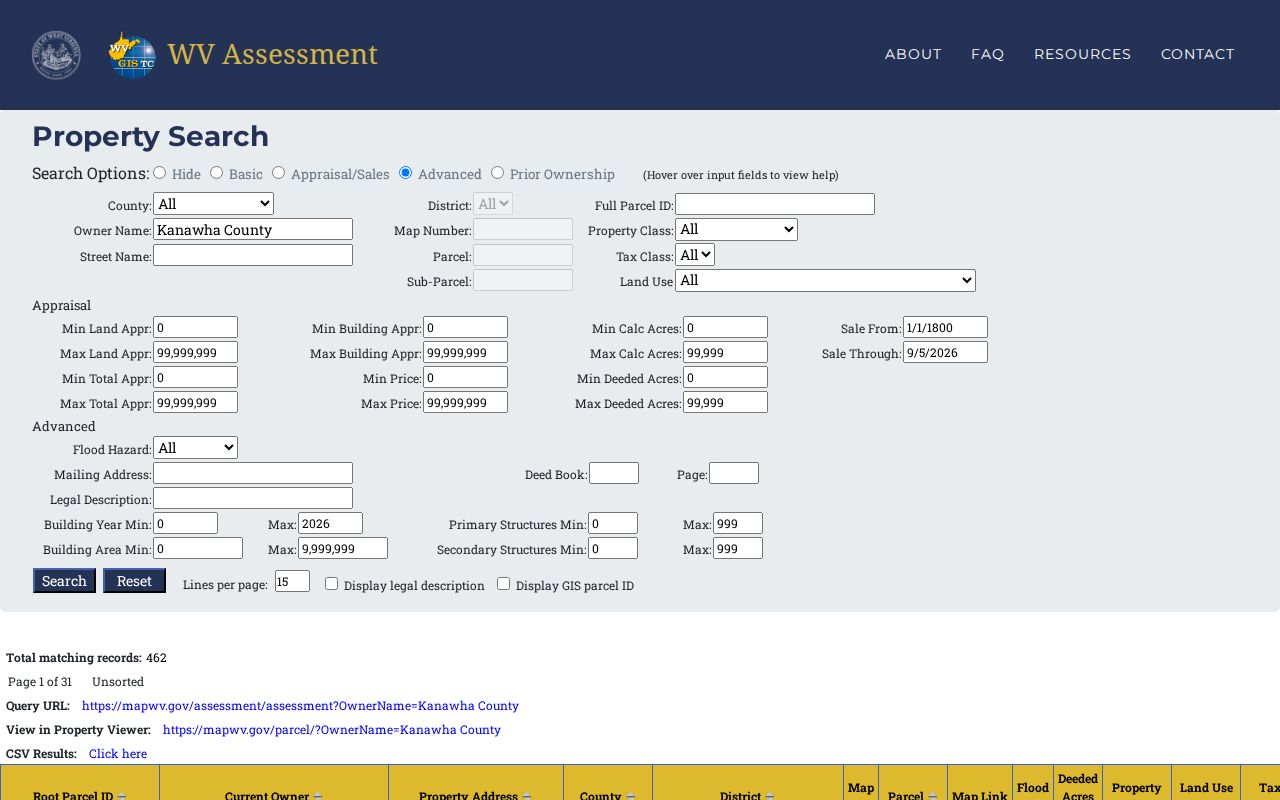
Compare the physical address with the mailing address, sales date, and deed reference. A same-address match can suggest owner occupancy, but the assessor does not certify who is present today. Preserve uncertainty when a trust, business, or out-of-county mailing address appears.
Kanawha Block Voter Data
West Virginia's public voter lookup is person-specific. It takes first name, last name, and date of birth, not a street, ZIP, or map radius. The result can show registration status, party, districts, and polling place. It updates nightly. This makes it useful for confirming a known person, but unsuitable for freely browsing every voter on a block.
A formal voter-data request can include name, residence address and county, with optional mailing address, precinct, and political districts. The Kanawha County voter registration office is the local channel at 415 Quarrier Street, 304-357-0110. Request scope, format, and current charges should be confirmed before ordering.
Sensitive fields remain private, including Social Security, driver's-license or state-ID numbers, telephone, and email. Voter history records participation, not ballot choices. Homeless registrants may use an approved location, and protected voters may use a substitute address, so not every published residence represents a conventional home.
Kanawha Neighborhood Groups
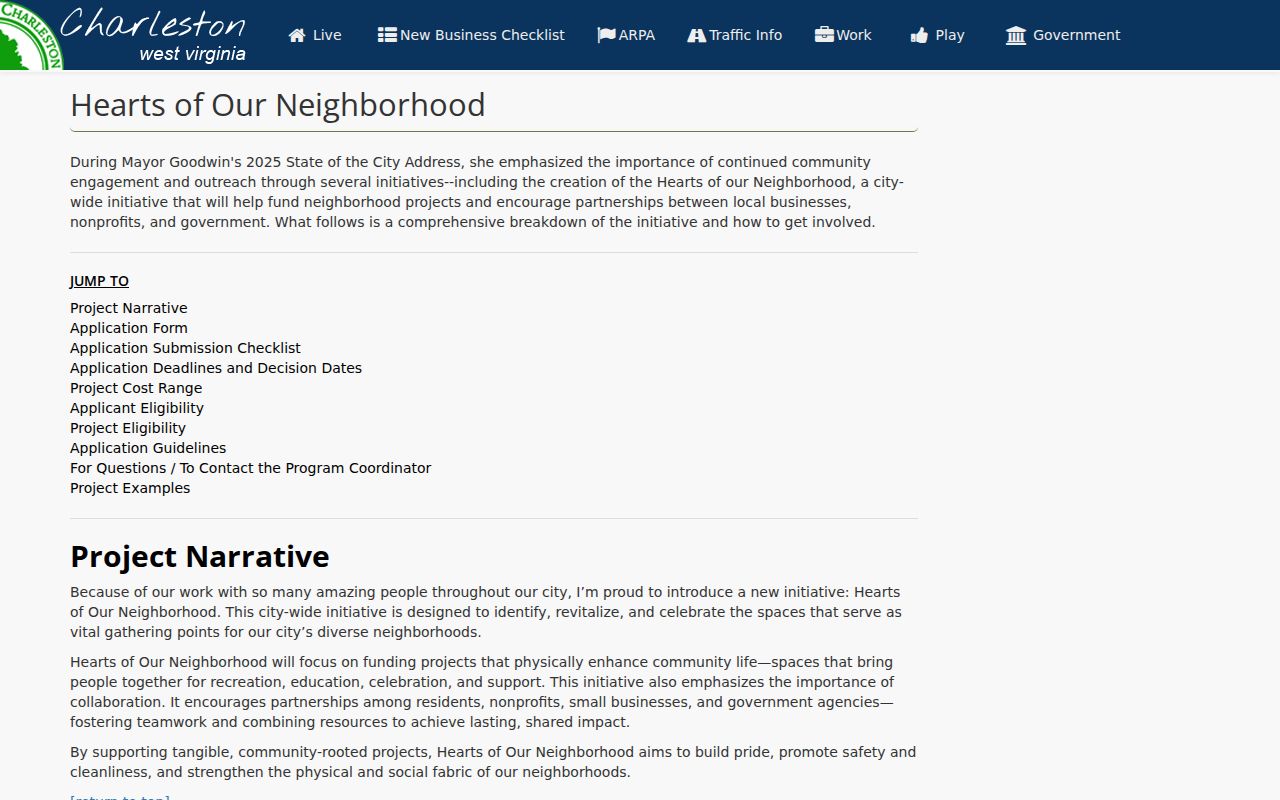
Public civic groups add context that property rolls cannot. Charleston's Hearts of Our Neighborhood program accepts neighborhood groups, nonprofits, faith-based groups, educational institutions, community associations, and other eligible participants for local projects. It publishes program and project information, not a roster of households.
The official Hearts of Our Neighborhood page shows the public-facing community program used for Charleston block context.
Hearts of Our Neighborhood
Use the city program page to identify public projects and the coordinator. Do not infer membership from a project location.
Charleston Ward Locator
Enter a full address to identify local, state, and federal representatives for civic context.
KCPL Local History
Use Polk directories and newspaper microfilm for dated block and community research.
The city planning layer recognizes Downtown, West Side, East End, North Charleston, Edgewood, South Hills, Oakridge/Greenbrier, and Kanawha City. Those names help organize a search. They do not reveal private association membership. Current church, veterans, union, alumni, and congregation rosters should also be treated as private unless an organization has chosen to publish historical material.
Official Kanawha Neighbor Sources
Official sources have narrow meanings and named custodians. Commercial neighbor tools often combine public filings with copied profiles, and their dates or identity matches may be unclear. Use the source that directly answers the question, then keep its date and limits.
| Source type | Strength | Main limit |
|---|---|---|
| Assessor and parcel map | Current tax parcel and assessed owner | Not a list of occupants |
| Voter custodian | Defined public registration fields | Person lookup and protected-field limits |
| Public civic group | Named projects, events and contacts | No private member roll |
| Commercial compilation | May combine several leads | Stale data and merged identities |
When an official record looks wrong, contact its custodian with the parcel, case, or record number and proof. Republishing a disputed result does not correct the government source.
Past Kanawha County Neighbors
For an older block, Kanawha County Public Library holds Polk's Charleston city directories from 1908 to the present as a cataloged run, though not every year is guaranteed on shelf or online. A criss-cross section, when present, arranges entries by street and number. It can place dated occupants next to one another without claiming that the same people remain there now.
The library also holds Charleston Daily Mail microfilm from 1914 and Gazette film from 1924. Neither is indexed. With a date, local news, legal notices, and obituaries can connect households to a community event or family. Historic work should keep the directory year, page, street spelling, and source citation because Charleston and nearby place labels have shifted.
For earlier land ties, the State Archives microfilm list reaches back much farther than the directories. Kanawha deeds begin in 1790, grantor indexes in 1790, and grantee indexes in 1795. A grantor is the party transferring an interest; a grantee receives it. Those indexes trace owners, not all people who shared a home. The County Clerk Record Room and Archives are the fallback when an image is not online.
A 1902 Charleston Sanborn map adds building shape, use, and street context. It can show whether today's parcel once held a different structure, but it does not name every resident. Pair the map with the nearest dated directory and deed reference. This keeps past households in the correct era and prevents a historic name from being read as a current contact.
Privacy for Kanawha County Neighbors
West Virginia's Address Confidentiality Program serves qualifying survivors of domestic violence, sexual assault, stalking, and human trafficking. A participant may use a designated substitute address for voter registration and other government dealings. That address is not the person's home and should never be mapped as one. First-class mail forwarding is part of the program, and enrollment generally lasts four years.
Utility accounts, private delivery data, restricted vital certificates, sealed court records, and sensitive voter fields are not general block-search sources. A public owner name does not open the private lives of the people at that parcel. Contact should remain respectful, and a person can decline it.
Lawful use. Research about a Kanawha County block must remain personal and lawful. Never use an address or name to stalk, harass, intimidate, or harm anyone.
A careful block record ends with source notes, not certainty about unseen household members. Date each parcel card and voter result. Mark substitute, mailing, business, and post-office addresses clearly. These steps protect both accuracy and the privacy that West Virginia law preserves.
When public contact is needed for a civic reason, use a published association or city-program contact rather than a presumed home address. Charleston's ward tool and neighborhood program provide safer paths for local questions. County areas outside Charleston may require the relevant municipality or County Commission contact. No complete countywide association directory was located, so absence from a public page says nothing about whether a group exists.