
Kanawha County Directory Collections
The strongest continuous shelf is the Kanawha County Public Library local history collection. It identifies Polk's Charleston City Directories for Charleston and neighboring suburbs from 1908 to the present. Access is through the library and catalog, not a promise that every volume has been scanned. The official page gives no year-by-year gap list and names no separate reverse-directory run. Ask reference staff to confirm the title, year, and location before traveling.
| Collection | Date span | Keeper | How to use it |
|---|---|---|---|
| Polk's Charleston City Directories | 1908-present | KCPL Main local history | In-library name and address research; verify gaps |
| Charleston Daily Mail film | 1914-current | KCPL Main | In person, not indexed; bring a date |
| Charleston Gazette film | 1924-current | KCPL Main | In person, not indexed; bring a date |
| Kanawha county record film | 1790s onward, varies by series | WV State Archives | Microfilm and limited written research |
| Kanawha County Genealogies A&M 0933 | 1711-1955 | WVU WVRHC | Open access; reproduction may need permission |
| Charleston Sanborn map | 1902 inspected | Library of Congress | Free online building and street context |
Catalog records elsewhere identify directories for Dunbar, Kanawha City, South Charleston, and St. Albans. Those hits do not prove that KCPL owns every edition. Confirm each item with its holding library. This matters because a household may appear under a suburb or nearby municipality even when its broader record trail stays in Kanawha County.
Kanawha County Library Directory Desk
The Main Library reference desk is the practical first contact for a city directory request. Call 304-343-4646 or email Reference@KanawhaLibrary.org with a surname, likely year, and municipality. Staff can check whether a Polk volume is onsite and point to the catalog. KCPL describes its physical emphasis as local history rather than a broad genealogy collecting program, so a focused question works best.
The KCPL genealogy and local history page also connects researchers to FamilySearch, the West Virginia vital-record archive, historic newspapers, and funeral-home material. Its access notes matter. Some databases may require an in-library session, while directory volumes and newspaper film remain physical sources.
The library's genealogy and local-history page shows the present entry point to these sources.
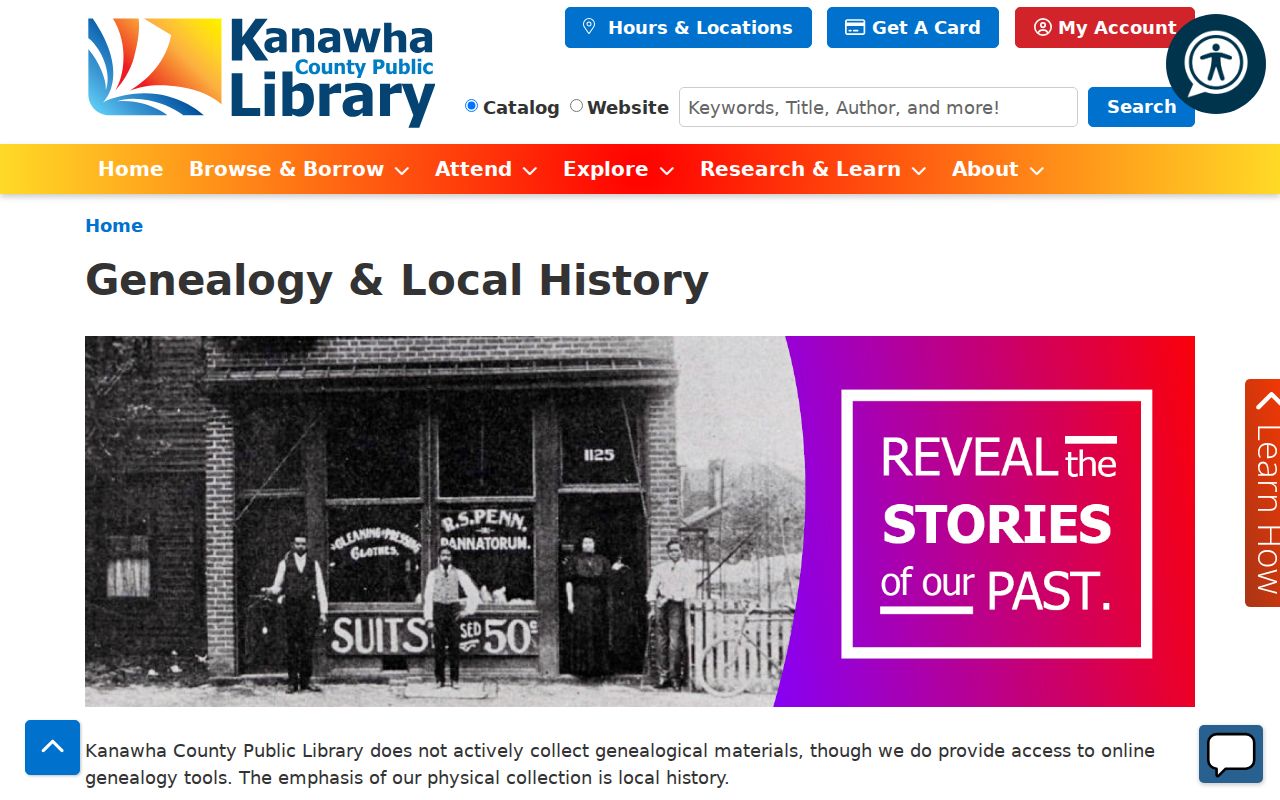
The screen is a discovery aid. Confirm the exact volume and access method with staff before treating a catalog result as a digitized book.
Read Kanawha City Directory Entries
An entry is a dated lead, not a full resident record. Common directory conventions include a surname and given name or initials, street address, work or trade, employer, spouse, and widow notation. Symbols may also distinguish a residence, a boarder, or an owner. No official digitized Kanawha Polk page was available for exact transcription, so always use the key printed in the volume rather than assuming one year's marks match another.
| Printed name | Copy spelling, initials, and suffix exactly as shown. |
|---|---|
| Street address | Record the number, abbreviation, suburb, and any unit notation. |
| Work detail | Occupation or employer can separate two people with the same name. |
| Household note | Spouse, widow, boarder, or householder marks may connect relatives. |
| Citation | Save volume year, page, and the directory's own publication details. |
- Criss-cross directory
- A later directory arranged by street and house number instead of only by surname. A distinct Kanawha run has not been confirmed.
- Householder index
- An address-order list used to move from a place to the named person printed there.
- Abbreviation key
- The volume's guide to marks and shortened words. Photograph it before interpreting an entry.
Directory information may have been gathered before the cover year. Check the preface for the canvass or publication date, and keep that uncertainty in the citation.
Before Kanawha City Directories
Polk's confirmed Charleston run begins in 1908, but Kanawha name trails reach much farther back. The WV State Archives county microfilm list includes deeds from 1790 to 1910, personal-property tax lists from the 1790s through 1861, marriages beginning in 1794, and a Register of Free Negroes for 1828 through 1857. These sources can place a person in the county when no city directory exists.
Kanawha County formed in 1789 while the area was still Virginia, and Charleston was chartered in 1794. Cite the record group as printed. A Virginia-era county court book is not the same source as a later West Virginia circuit file. Archives staff also warn that date ranges may contain missing volumes, so a span is a search map rather than proof that every year survives.
The WVU Kanawha County Genealogies record preserves another path into named family research.
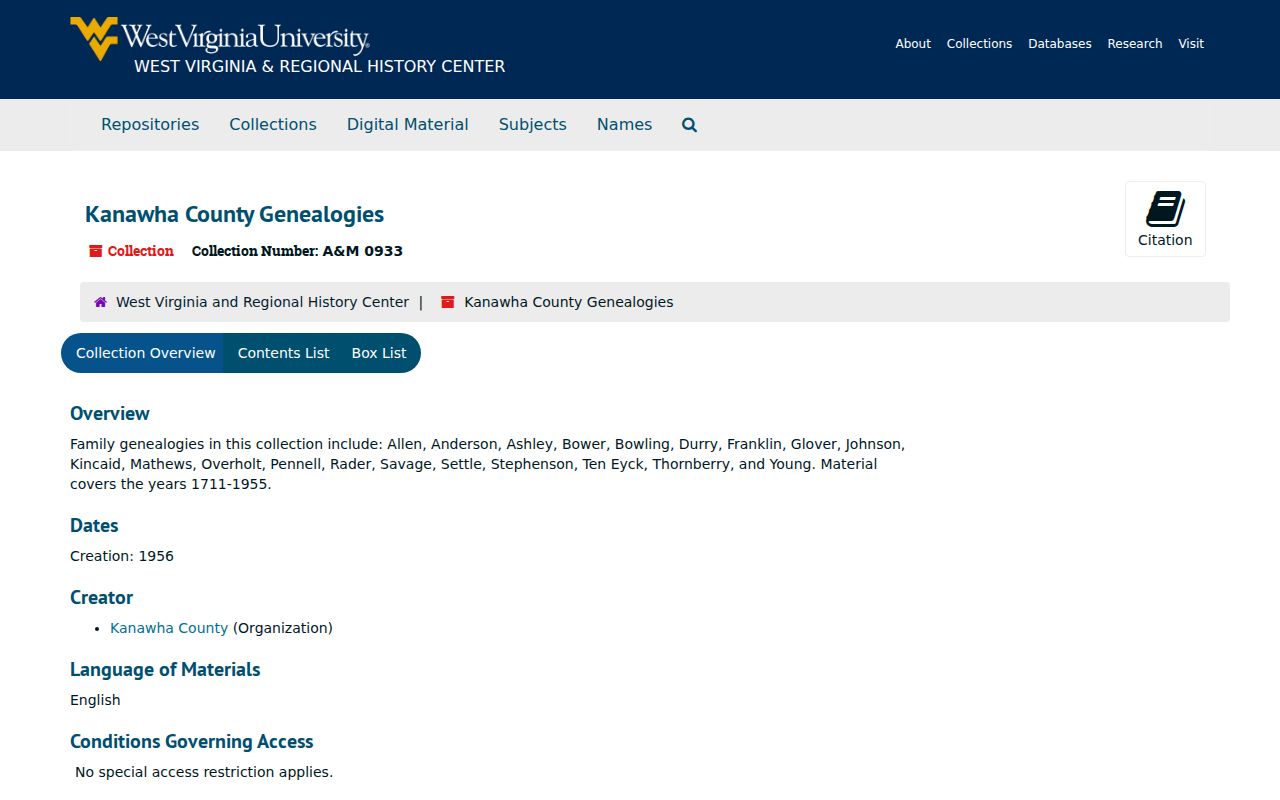
For named family collections, the WVU record identifies the collection number, date range, access status, and citation details needed for a precise request.
Kanawha Directory Research by Request
When travel is not possible, the WV State Archives accepts written research requests. The service is deliberately narrow: two specific questions and no more than one-half hour of staff time. The nonrefundable fee is $10 for a West Virginia resident and $20 for someone outside the state, with added copy costs. The Archives does not answer research requests by email.
Insider tip. Supply a full name, one place, one date range, and one record type so each question can be completed within the staff limit.
A request such as “check the 1920 and 1921 Charleston directories for this surname” is more workable than a broad family search. For the library, use the phone or reference email. For archival film, follow the WV Archives service instructions and include enough detail to distinguish the person.
Trace Kanawha Families by Directory
A Kanawha County city directory works best as one frame in a sequence. Follow the printed name across nearby years, retain each address and occupation, then compare the household with a census schedule. Public individual federal schedules are governed by the 72-year rule, and 1950 became public in 2022. A directory beside a census year is evidence from a nearby date, not evidence gathered on the same day.
- Find the surname in a likely Polk year and copy the entry exactly.
- Check the year before and after it for moves, spelling variants, or a new spouse notation.
- Search the address section if that volume has one, then note nearby numbers and cross streets.
- Compare a directory one or two years from a public census and preserve each source date.
- Test a disappearance with deeds, an obituary, probate, or cemetery records.
A missing entry can mean a move, death, missed canvass, altered boundary, or spelling error. Do not choose one cause until another record supports it. If modern address work is the goal, use the Kanawha County street directory rather than extending a historical entry into the present.
Kanawha Directory Names in Newspapers
KCPL holds Charleston Daily Mail microfilm from 1914 forward and Charleston Gazette film from 1924 forward. Neither run is indexed. A date from a city directory, death record, marriage record, or court notice can shrink a difficult film search to a manageable span. Newspaper notices may add relatives, a funeral home, church, old address, or community role.
KCPL's obituary lookup needs the person's name and date of death, plus contact information and a self-addressed stamped envelope. Copies cost $0.25 each. This human search can bridge an old address to a spouse or child, but it is not a broad name-only index. The library page also lists Harden & Harden Funeral Home records alphabetically, without a confirmed date range.
The KCPL local history overview shows these newspaper and obituary channels.
The resource list makes the limits clear: a new catalog does not turn unindexed physical newspaper film into a full online people search.
Note: Bring a firm date to newspaper film, since the Daily Mail and Gazette collections do not have a complete name index.
Kanawha City Directories and Industry
Occupations help explain why the same family moved through the Kanawha Valley. Salt led the late nineteenth-century economy, coal grew after salt declined, and the C&O Railway supported that shift. Chemical plants, state government, health care, and education later shaped the entries found in Charleston-area volumes. An occupation or employer can separate two residents with the same name, but it does not prove a present address.
The 1902 Charleston Sanborn map adds street and building context before the confirmed Polk run. Its 16 sheets can show building form, lot layout, street names, and industrial use. It does not identify an occupant. Pair a map sheet with a later directory, deed, and tax record instead of reading a person's name into the map.
Place labels deserve the same care as names. A household might be printed under Charleston in one source, Kanawha City in another, and a county tax district in a third. Dunbar, South Charleston, St. Albans, Nitro, and rural communities also create distinct catalog paths. Keep the original place wording beside each citation. Normalizing all of them to Charleston can hide a move or send the next search to the wrong directory volume.
For a person tied to a university, church, veterans group, or civic club, a yearbook, commencement program, reunion notice, or historical newsletter can supplement the city directory. No complete current Kanawha membership directory was found. Search library and archive catalogs for dated publications, then request the named item or box. A historical roster shows an affiliation at that time only.