
Find Kanawha County Residents
Begin with the kind of fact already in hand. An address fits the free county assessor search. A full name and date of birth fit the state voter lookup. A book and page belong with the County Clerk. A name from an earlier decade belongs in library directories, newspapers, census schedules, and archival indexes. These sources form a useful Kanawha County residents directory only when their purposes and dates are respected.
Ownership is not residence. Tax mail may go to an agent or an owner outside West Virginia. A voter record confirms one registered voter, not a whole household. Court and vital records add identity or event evidence, but neither is a current address list. Keep spelling, date, district, and source with each result.
- Search the assessor by owner or parcel address; save parcel ID, legal description, and deed book/page.
- Use GoVoteWV with first name, last name, and date of birth.
- Check WVPASS and the separate magistrate system when court context can distinguish the person.
- Move older names into Polk directories, newspaper microfilm, and historical indexes.
- Call, visit, mail, or send a precise request when no portal covers the record.
Kanawha County Directory Offices
Charleston is the county seat and state capital, so several custodians sit close together but hold different records. The County Clerk records deeds, liens, wills, judgments, vital events, and election material. The Assessor maintains ownership and parcel facts. The Circuit Clerk keeps circuit, family, and mental-hygiene files. Vital Registration and the State Archives add certificate and historical channels. The Kanawha County street directory explains the full address chain.
Search Kanawha Property Records
The Kanawha County Assessor Property Record Search accepts any combination of fields and is free. Enter owners as LAST NAME FIRST NAME without a comma. Results can show the current owner, mailing address, physical or E-911 address, district, parcel ID, legal description, values, sales history, building card, flood details, and deed book/page.
The official form shows how one residents directory source can be approached by name, place, or deed reference.
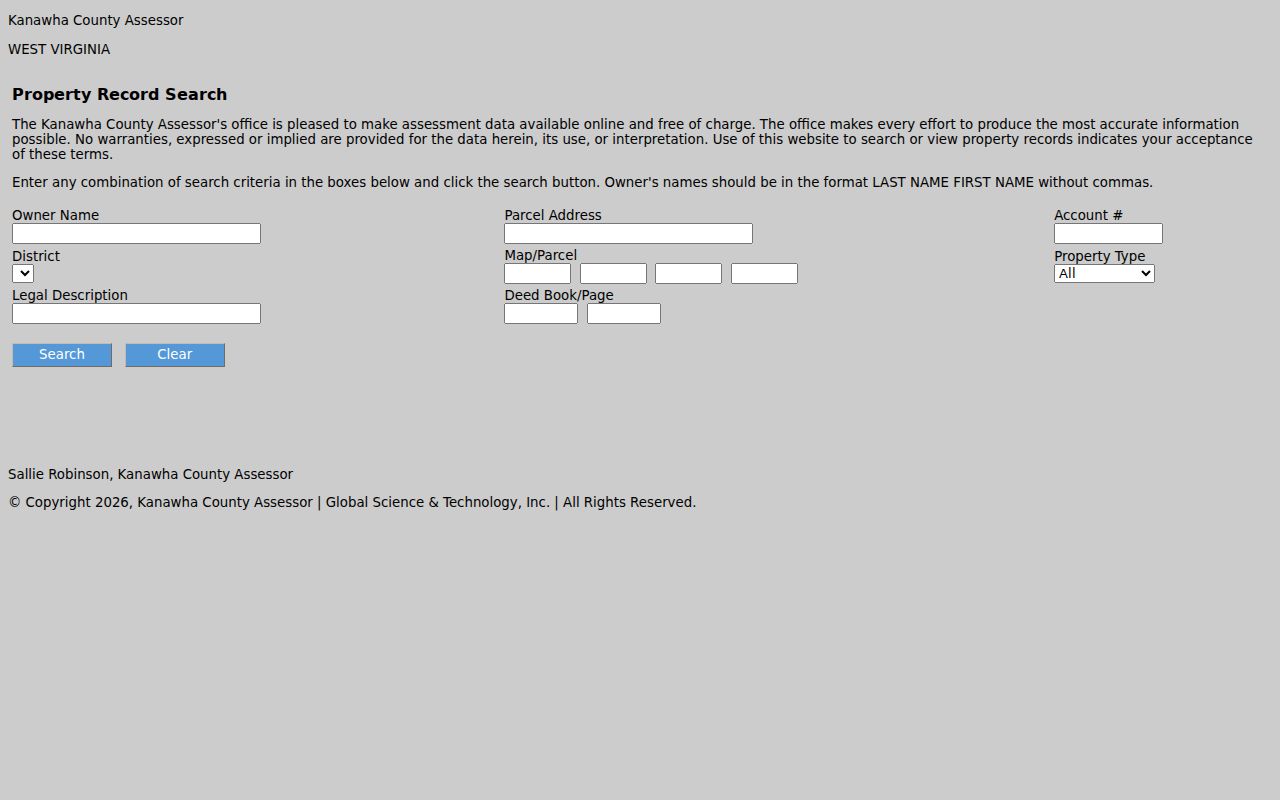
The mailing field is where tax notices go. The situs field identifies the parcel's physical place. Never treat the first as a home address without support.
| Field | Format | Use |
|---|---|---|
| Owner | LAST NAME FIRST NAME | Name to parcel |
| Parcel Address | Address text | Place to owner |
| Account | Eight digits | Known assessment |
| District, Map, Parcel | Separate codes | Resolve similar addresses |
| Legal Description | Text | Bridge changed labels |
| Deed Book/Page | Separate fields | Recorded-record handoff |
Current Kanawha County Resident Rolls
No official source is a master residents directory. Each roll answers one question. The assessor names owners. The voter system confirms a known person. Deeds name transfer parties. Court indexes identify case parties. Charleston municipal records identify candidates, cemetery entries, and people named in public business.
| Source | People shown | Keeper | Access |
|---|---|---|---|
| Assessment | Owners | Assessor | Free online |
| Voter lookup | Matched voter | Secretary of State | Free person search |
| Deeds | Grantors and grantees | County Clerk | Record Room, counter, request |
| Court index | Public case parties | Judiciary | Two online systems |
| City records | Named public participants | City Clerk | Counter, phone, fax, writing |
A parcel ID is stronger than a loose name match. A birth date narrows voter results. A case number distinguishes court matters. Renters and unlisted household members do not form a complete public roll.
Kanawha Voter Directory Limits
The GoVoteWV lookup requires first name, last name, and date of birth. It can return status, party, political districts, and polling place. The system updates nightly and has a midnight-to-2 a.m. maintenance period. A fuller voter file requires a formal data request.
Public file fields can include residence address, county, party, status, registration date, precinct, and districts. Social Security numbers, state-ID or license numbers, phone numbers, and email are withheld. Protected voters and Address Confidentiality Program participants need added safeguards.
Kanawha County Court Lookups
WVPASS covers public circuit cases filed since July 1, 1999. Browsing is free, while document downloads cost money. Statewide access launched March 10, 2025. The Magistrate Case Record Search is a separate CAPTCHA-gated system whose disclaimer directs users to the clerk for validation.
Older, restricted, or certified circuit material remains with the Circuit Clerk. Charleston Municipal Court has its own docket and clerk. Compare names, dates, case numbers, and court level before joining a result to the Kanawha County residents directory.
Vital Records in Kanawha County
West Virginia Vital Registration in Charleston issues certified birth, death, marriage, and divorce records. Current certificates require a form, ID, payment, and an authorized relationship. The listed fee is $12. In-person, mail, and authorized online routes are available. The County Clerk handles local records and marriage-license questions.
West Virginia Code §16-5-27 opens births after 100 years and deaths, fetal deaths, marriages, and divorces after 50 years. The Vital Research Records Project is for historical research, not certified copies. Archival Kanawha birth and death books run 1853-1967, with scattered earlier births.
When Kanawha Portals Stop
The County Clerk page offers no live deed index or current cutoff. Call the Record Room, visit on weekdays, or send a focused request with names, dates, record type, parcel facts, and book/page. Archives microfilm has deeds for 1790-1910, grantor indexes for 1790-1946, and grantee indexes for 1795-1967.
The West Virginia Freedom of Information Act, W. Va. Code §29B-1-1 et seq., gives every person access to nonexempt records from their custodian. Response is due as soon as practical and within five days excluding weekends and holidays. Actual copy cost may be charged, not search labor. Archives staff accept written research requests only, with two specific questions and one-half hour of work.
Official Rolls Versus Compilations
Official rolls are narrow but verifiable. Commercial people-finder compilations blend public, purchased, and user-supplied data. They may duplicate names, retain old addresses, or expose a protected person. Never use a private compilation as proof of residence.
| Source | Strength | Limit |
|---|---|---|
| Official custodian | Known purpose and keeper | One record class |
| Library or archives | Dated evidence | Gaps and on-site items |
| Private compilation | Broad lead | Unknown freshness |
Use records lawfully. Public access does not permit stalking, harassment, intimidation, or harm. Verify sensitive facts with the custodian.
Kanawha Address Record Terms
Four labels make the directory trail easier to follow.
- Roll
- A list kept for an official purpose.
- Index
- A finding aid that points to the complete record.
- Parcel
- A mapped unit of assessed land.
- Criss-cross directory
- A directory arranged by street or address.
One MapWV parcel may carry several E-911 addresses plus a different tax mailing address. Count parcels, units, owners, and occupants separately.
Historical Kanawha County Directories
The Kanawha County Public Library lists Polk's Charleston directories from 1908 to the present. Entries can supply a name, spouse, work, or address. The main branch also has Charleston Daily Mail microfilm from 1914 and Gazette microfilm from 1924. Neither newspaper run is indexed.
The Kanawha County city directory collections help trace a household across years. Obituary requests need a death date, a stamped return envelope, and one quarter per obituary. Archives extend the residents directory before 1908 with deeds, tax lists, marriages, wills, and court books.
Kanawha Records Across Time
Kanawha County formed in 1789, and Charleston was chartered in 1794. Early records predate West Virginia statehood. A Virginia county court book, later circuit file, county deed, and state certificate may concern one family without being interchangeable.
Digitization came in layers. Current assessments are online. Land books from 1791-1962 are online while scanning continues. WVPASS starts with 1999 public circuit cases. Newspaper microfilm stays physical and unindexed. A blank result may reflect coverage, retention, privacy, or a catalog gap, so follow it with the clerk, library, or Archives.
Kanawha Deeds and Probate Trails
The County Clerk records land and estate files that add names the assessment roll cannot explain. Start with the assessor deed book and page, then ask the Record Room for the transfer. A grantor gives property away or sells it; a grantee receives it. To move backward, locate the current deed, identify the seller, and search that seller as the grantee in an earlier deed. Copy the date, instrument type, book, page, legal description, consideration, lot or block, and release or lien clues. Fixed land descriptions often survive when a road label changes.
Probate can connect an owner to heirs. Kanawha holdings include wills from 1820 through 1968, indexes to wills and fiduciary matters from 1831 through 1938, and fiduciary settlements from 1871 through 1968. A fiduciary manages an estate. Facts may occur in wills, settlements, estate deeds, and newspaper notices. Ask the County Clerk for current files and the State Archives for microfilm. A delinquent-tax entry is only a lead and never proves present ownership or residence.
Charleston Municipal People Records
Charleston City Clerk records add a city layer to the Kanawha County residents directory. The office at 501 Virginia Street East keeps municipal-election documents, cemetery records, City Council minutes, committee reports, financial statements, and ordinance abstracts. These are open by counter, phone, fax, or written request. No city-operated general people-search portal was located. Candidate filings identify candidates and committees, not all residents, while cemetery records can supply evidence about a deceased person and family ties.
Address research may reach Development Services. Charleston permits can name the owner, contractor, project, permit number, inspection type, and dates. No public permit-by-address index was found, so call staff, visit the counter, or make a specific request. Permit evidence dates a building change; it does not establish occupants. Code enforcement uses tax records for owner notices, showing why the assessor is the common handoff between city and county files.
Privacy in Kanawha Resident Searches
Some absences are deliberate. The West Virginia Address Confidentiality Program lets qualifying survivors use a substitute mailing address in voter, motor-vehicle, school, child-support, and other government dealings. Enrollment lasts four years, and first-class mail is forwarded without charge. Never try to reverse engineer a protected address.
Motor-vehicle data, utility accounts, delivery data, Social Security numbers, voter phone and email fields, sealed cases, and restricted vital records are not parts of an open household directory. One parcel can have several E-911 addresses. Kanawha County place labels also vary among Charleston, South Charleston, Dunbar, St. Albans, Nitro, and rural communities. Preserve the label from the original record.
Kanawha Archives Before Databases
The archival trail reaches far beyond modern directory screens. Kanawha County formed in 1789, while the region was still part of Virginia, and its surviving record groups reflect that change in government. State Archives microfilm lists county court books from 1788, personal-property tax lists from 1792, marriages from 1794, a Register of Free Negroes from 1828 through 1857, an 1835 precinct-election book, and courthouse account books from 1843 and 1849. These are not current resident lists. They are dated evidence that can place a named person in a tax district, legal proceeding, family event, or civic setting.
Use a narrow request. Archives staff do not accept research questions by phone or email, and written staff research is limited to two specific requests and one-half hour. Supply a full name, likely year, county, record group, and any known book or page. In-state written research costs $10, while the listed out-of-state fee is $20; certain copy requests carry separate fees. Broad family requests are not serviceable. When catalog dates contain gaps, ask whether the missing volume survives elsewhere rather than assuming the person left Kanawha County.